|
Why Gas Prices Are Actually Falling
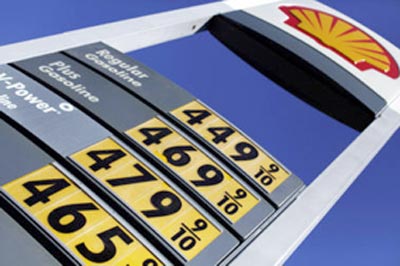
In a world of rising gasoline prices, Forbes tells us that gasoline prices are not actually rising, and in fact are lower than ever. And they ain’t lyin’! Writing for Forbes Louis Woodhill gets this seeming contradiction right. He views the price of gas not in terms of the depreciating monopoly money issued by the politically-empowered central bank…but in terms of the market’s favorite money: gold. When viewed in relation to gold, gas prices are low…only 82% of their average over the past 41 years. Gas prices aren’t high. The dollar is just falling, its value being undermined by politically-driven over-issue. So if you count the Fed-issued dollars as money — and are actually using it as a savings vehicles — then your world is being rocked by rising gas prices (and rising prices in everything else, too, except for computing power). But it’s not just the rising prices of everything that threaten all of us. In his article Mr. Woodhill reminds us:
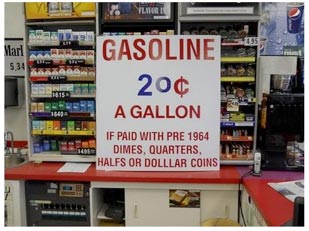
It amuses us that the “gold is for nutters” crowd loves to point out when a mere 250 of their beloved dollars could acquire the gold they hate so much. Yet they seem to forget that their dollars could buy more than ten times as much in the past — back before the Federal Reserve was established. They also write off those times when gold reveals the inherent weakness of their treasured paper currency…like when the gold price surged to $850 in 1980…and now as the price of gold hovers near $2000 thirty years later. If you look at it the right way — in terms of the eternal golden money — it’s the dollar’s periods of strength that are the aberration. It’s not gold and silver prices that are volatile. Those have been incredibly consistent for thousands of years in terms of commodities they could buy. And because of the increasing standard of living being raised by free market economies, in a very real sense these eternal monies actually buy more. It’s the dollar that has been erratic in its overall declining trend ever since it’s been cut loose from gold (and silver). Again, people looking at the cost of a gallon of gas, or of milk, or the cost of a nice suit, or rent from behind their piles of gold and silver are finding very little to worry about. In fact, to them, prices are lower than normal and declining. Also the price of oil has tended to track the price of silver awfully closely for about as long as oil has been industrially useful. And so it’s no mistake that you can still get a gallon of gas for about about $0.20…as long as that $0.20 is composed of a pre-1964 90% silver dimes.
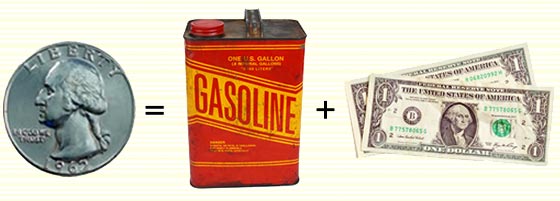
Or you could use a pre-1964 90% silver quarter for that gallon of gas and get back some change.
You see, the pre-1965 quarter is worth $6.38 as I type this. The pre-1965 dime is worth $2.55. These coins hail from a time when the dollar was still tied to gold (at the official price of $35 per ounce prior to Nixon nixing the gold standard). The dollar was still as good as gold — even though Americans themselves were forbidden to own gold bullion from 1933 till 1974 — and there was actual silver in the coinage until that content was reduced in 1964 and eliminated in 1965. Those old silver coins shine the harsh light on the strength of the currency and the abuse that currency suffers from the feds and the Federal Reserve. If you’d been saving in gold, then from your point of view gas prices have been coming down for the past few years. If you’d been saving in that old “junk” silver (pre-1965 quarters, dimes and half dollars), then gas prices are a downright bargain, too. (In fact, we strongly believe that silver is still severely undervalued. While gold is more than twice its 1980 high in terms of dollars, silver still hasn’t quite hit its 1980 all-time high when less than an ounce of silver could buy a barrel of light sweet crude. Silver may be more expensive in dollar terms than it was ten years ago…but it’s still incredibly cheap in terms of both gold and in terms of oil… …Back in 1980 at silver’s peak it took less than one ounce of silver to buy a barrel of oil. Oil is going higher…and silver is likely to try to play catch up and outpace both oil and gold. Silver is just as much a monetary metal as gold…and just as much a vital industrial commodity as oil. Yet again, silver is severely underpriced in relation to both gold and oil. And it stands to gain more than both as both climb higher. So physical silver has been and continues to be our favorite, simple way to hedge against the demise of the dollar. We turn now to the Wall Street Journal where they find U.S. monetary policy more than a little at fault for the rising dollar cost of gas…
It seems so simple to us. The politicians want to prop up certain markets with inflation from the central bank…while keeping it easy for the government to borrow. But like any man-made abomination worth its salt, those newly created dollars don’t ever behave exactly how their creators want. Stock and house prices are mostly flat or outright falling. The dollars meant to be puffing them up are instead spilling over into everything else. The housing market is like a sad, burst balloon. Air just flows in and right back out. The stock market seems to be filled to capacity, its size delineated by annoying fundamentals like earnings. The price for these earnings is just too high right now and more new money in the economy just can’t drive those stock prices much higher. That new money — the various QEs — is having an affect on other prices though. All the stuff you use to live. If you insist on believing in the dollar — and writing gold and silver off as barbaric nonsense — then you will be able to afford less and less of the life you want and to which you’ve become accustomed. Further if the history of paper monies is any kind, you could find yourself completely wiped out if you store your wealth in dollars or euros or pesos or whatever other paper lie is set to unravel next. They will tell you that creating new money is necessary to keep the economy growing, to fight unemployment, to promote the general welfare, etc, etc. But all it does is destroy your savings and make it easier for the feds to keep on borrowing to pay for welfare and wars. If you want to make sure the dollars you earn today can pay for the same amount of food and energy down the pike, trade those dollars for something of real value right now. We heartily recommend the type of money that actually fulfills that “reliable store of value” function. Regards, |
 |
 |