|
The Fed Conjures a Profit for Itself
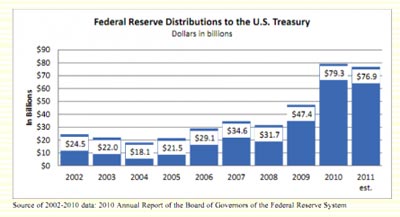
Just about this time last year, we reported that the Fed had pulled an $80 billion profit literally out of thin air. Today, the Federal Reserve did what it does around this time every year - it reported its income. The Federal Reserve Bank, a privately owned corporation with stockholders, is the largest bank in the United States by assets - larger even than behemoth Bank of America - which has over 6,000 branches and over 280,000 employees. Bank of America, with $2.3 trillion in assets representing over 12% of U.S. deposits, posted $6.3 billion in profit in 2009, a fairly slow year by its standards. The Fed, on the other hand, with its $2.4 trillion balance sheet, made Bank of America look downright sloth-like, posting an $80.9 billion profit. That is no small feat. Well, one year later, the Fed is about to write another near $80 billion check to the U.S. Treasury. ZeroHedge took to calling the Federal Reserve Bank of New York the “world’s most profitable hedge fund,” and as we wrote yesterday, central bankers aren’t above a little inside trading to scoop some cream off the top. But where does that $80 billion come from? Just imagine if you could print cash to buy assets - how could you fail to profit? Just like any profit, the Fed's profit is merely a wealth transfer. The big question is, to whom is wealth transferred, and who is the loser? The answer is that anyone with a dollar bill in his or her pocket is a loser, as the Fed simply conjures up more cash to make “investments” in insolvent banks and to purchase assets in order to prop up a façade of economic spring. So next time you think about taxes, don’t just think of the check you write to the IRS every April; think about the purchasing power of your dollars, rotted away by the Fed’s “investments.” Here’s the Fed’s statement:
Open Market Operations are one of the most powerful and the most frequently used monetary policy tools given to the U.S. Federal Reserve under the Federal Reserve Act of 1913, and the Great Depression was the Fed’s first major experiment in wielding this tool. The experiment ended in abject failure. Through Open Market Operations, in an attempt to manipulate short-term interest rates and ease the country’s suffering, the Fed sold U.S. securities to private banks. The securities sales sucked up excess cash, leaving even less to lend, and contracted the money supply even further, ravaging America’s economy. Activist government responses such as this one prevented the free market from healing itself, turning a bad recession into the Great Depression. |
 |
 |