|
Why you should expect $1000/oz Silver
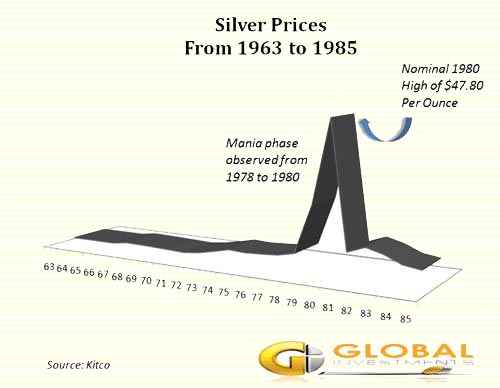
However, what these investors need to remember is that not too long ago, people were fretting over changes in prices of ten cents or less. Not too far down the road, the difference between $29 silver and $50 silver will also seem rather minimal. In observing previous silver bull cycles such as the last one which climaxed in 1980 (see chart below), we can gain a better understanding of what to expect this time around: In 1966, silver was being sold for $1.29 per ounce. In January of 1980, silver peaked at $48.70 per ounce. That is a massive increase of 3675%. However, comparing the 1970s silver bull market with that of 2011-2012 only gives us a minimal window into what we can begin to expect, as this time, the silver market will be open to the world at large. Unlike in 1980, this market will not be restricted to Western Europe and North America. Furthermore, populations around the world have much more of an investor mindset than people did in the 1970s. For this reason, we can find many more millionaires and billionaires around the world than we could then.
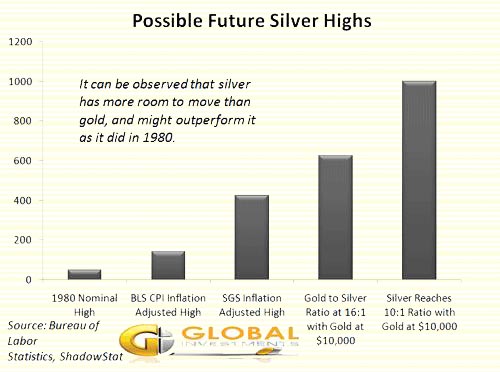
The approximate tenfold increase of the monetary base of the world's reserve currency will also play an important part in determining silver's ultimate price, as will the fact that silver's price has been suppressed for such a long period of time. However, the most important factor in the future unleashing of silver's true price discovery mechanism will be the fact that a large portion of the silver that existed during the 1970s period has been used up and thrown away in landfills through decades of industrial, medical and electronic applications. We will most likely never see that silver again. The following chart outlines a series of more realistic future highs that silver might eventually reach:
The first column of this chart shows the 1980 nominal high of $48.70 per ounce. The second column shows this 1980 high in inflation adjusted terms using the present U.S. government's official CPI calculation method. Today's official inflation adjusted high for silver is $142.02 The final two columns examine possible silver highs from the perspective of the Gold to Silver ratio. If gold is to do its traditional accounting of today's reserve currency monetary base, we expect to see Gold prices of at least $10,000 before this bull market is over. Although we expect to see higher prices than this as global wealth rushes to enter into this limited market and fiat monetary bases continue to expand, we prefer to stick to numbers that can be validated by data and past historical experiences, such as the gold to monetary base accounting process which occurred in both 1934 and 1980. G.I. Metals expects the current gold to silver ratio to correct itself to its historic standard of 16 to 1, which entails being able to purchase 1 ounce of gold with 16 ounces of silver. Column four of the above chart shows that with gold at this relatively conservative top of $10,000 - if silver is at its historic 16:1 average in relation to gold - silver will be $625 per ounce. Because there is actually more gold than silver on the earth at this time due to industrial consumption, it is conceivable that silver could overshoot this historical monetary ratio and reach a number such as 8, 9 or 10 to 1. Although there has usually been between 12 to 16 times more available silver than gold, presently, there is incredibly more gold than silver. If silver does reach a 10 to 1 ratio as it has done before at different times throughout history, then we would be seeing a price of $1000 per ounce, as demonstrated in the fifth column. In reality, there is no precise way to determine exactly how high gold and silver will eventually go. One thing is sure, however, and that is the degree to which gold and silver are still undervalued in comparison to other global assets, and just how undervalued silver is compared to gold. Gold reached its 1980 nominal high of $873 in the first month of 2008, whereas silver only reached its 1980 nominal high in the summer of 2011. Clearly, both assets are still under-owned and undervalued, with silver much more so than gold. Although G.I. Metals DMCC projects that silver will outperform gold in the long run, its speculative quality and volatility is not for everyone. However, we suggest that those who can handle this volatility should have physical exposure to silver and its remarkable fundamentals which are still - for the most part - undiscovered. |
 |
 |